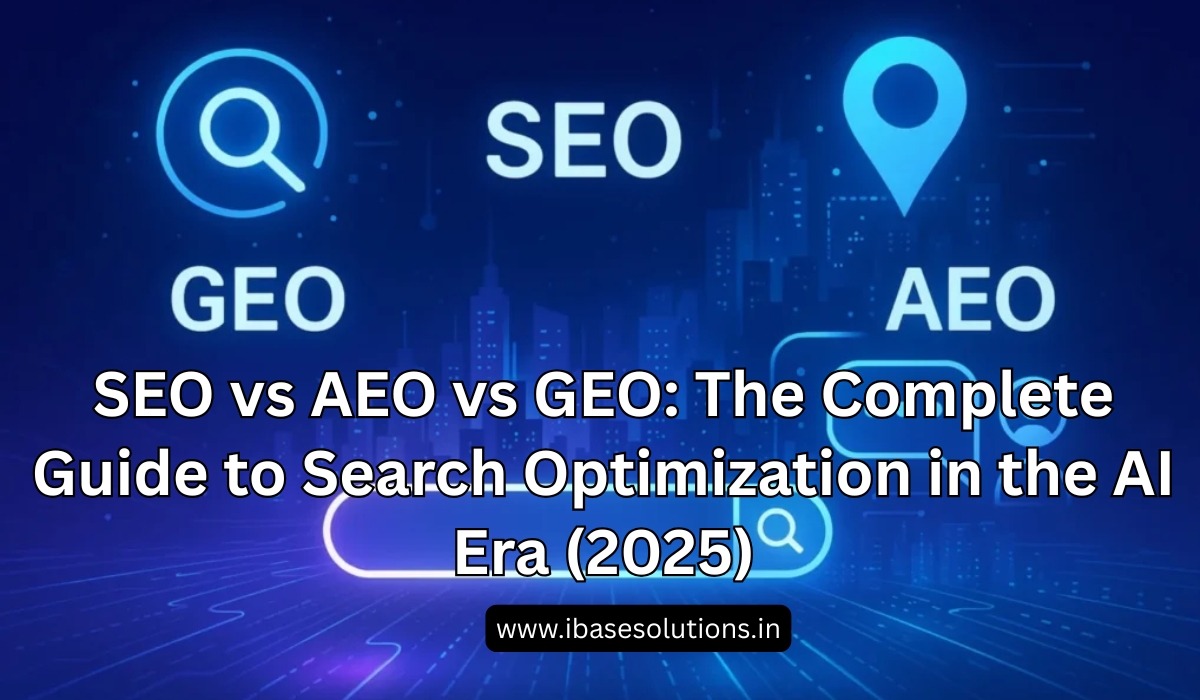
SEO vs AEO vs GEO: The Complete Guide to Search Optimization in the AI Era (2025)

Introduction

Search optimization has evolved far beyond traditional Google rankings. In 2025, brands must think in three dimensions of visibility:

  • SEO – Search Engine Optimization
  • AEO – Answer Engine Optimization
  • GEO – Generative Engine Optimization

Each serves a different purpose in how users discover information—through search engines, voice assistants, and AI-powered platforms like ChatGPT, Gemini, and Perplexity. Understanding how these models differ is now critical for digital growth.


1. SEO – Search Engine Optimization

Definition

SEO is the practice of optimizing web pages to rank higher in traditional search engines like Google and Bing.

What It Is

SEO focuses on keywords, backlinks, content quality, and technical site health to increase organic visibility in search results.

How It Works

  • Research and target high-intent keywords
  • Optimize on-page content and metadata
  • Build authoritative backlinks
  • Improve site speed, UX, and mobile performance
  • Use internal linking for crawl depth

Use Cases

  • A local clinic ranking for “best dental clinic near me”
  • An e-commerce site ranking for product keywords
  • A SaaS company ranking for solution-based searches

Pros

  • Steady long-term traffic
  • High commercial intent
  • Strong return on investment
  • Foundation for all other optimization methods

Cons

  • Highly competitive
  • Slow time to results
  • Sensitive to algorithm updates
  • Requires continuous maintenance

How to Rank Higher with SEO

  • Target topic clusters instead of single keywords
  • Refresh existing content regularly
  • Perform quarterly technical audits
  • Strengthen internal and external link profiles

2. AEO – Answer Engine Optimization

Definition

AEO is the process of optimizing content to appear as direct answers in zero-click searches, featured snippets, and voice search results.

What It Is

AEO focuses on structuring content so it can be easily extracted by Google for “People Also Ask,” voice assistants, and quick answer boxes.

How It Works

  • Write short, direct answers (30–50 words)
  • Use FAQ and How-To schema
  • Format content using lists and tables
  • Target question-based search terms

Use Cases

  • A finance blog ranking for “What is GST?”
  • A parenting portal ranking for “How many hours should a newborn sleep?”
  • A HR website answering “How to calculate gratuity?”

Pros

  • Instant authority and trust
  • High visibility without needing high rankings
  • Strong presence in voice search
  • Boosts brand recall

Cons

  • Many users don’t click through
  • Snippet ownership changes frequently
  • Requires frequent content updates

How to Rank Higher with AEO

  • Optimize for “People Also Ask” keywords
  • Add structured FAQ schema
  • Clearly label questions using H2/H3 tags
  • Use bullet-point answers

3. GEO – Generative Engine Optimization

Definition

GEO focuses on optimizing content so it is referenced, summarized, or cited by AI platforms such as ChatGPT, Gemini, Claude, and Perplexity.

What It Is

Instead of ranking web pages, GEO helps brands appear inside AI-generated answers as trusted sources.

How It Works

  • Publish fact-based, structured content
  • Build mentions on trusted platforms (Reddit, Quora, Wikipedia-style sources)
  • Use clear formatting, headings, and citations
  • Improve E-E-A-T (Experience, Expertise, Authority, Trust)

Use Cases

  • A fintech company being recommended by ChatGPT
  • A law firm cited in AI responses on business compliance
  • A travel brand used in AI-generated itineraries

Pros

  • First-mover advantage in AI search
  • Establishes brand as a knowledge authority
  • Captures emerging AI-driven traffic
  • Builds trust without traditional ranking

Cons

  • Hard to track direct ROI
  • AI citation rules are still evolving
  • Requires strong off-site reputation
  • Needs multi-platform presence

How to Rank Higher with GEO

  • Publish factual, well-cited content
  • Maintain presence on platforms AI uses as training signals
  • Use tables, FAQs, and structured formats
  • Build digital authority across the web

SEO vs AEO vs GEO: Quick Comparison

Factor SEO AEO GEO
Primary Goal Rank in search results Appear in featured answers Be cited in AI outputs
Platform Google, Bing Google snippets, voice search ChatGPT, Gemini, Perplexity
Traffic Type Click-based Zero-click / short-click AI recommendation traffic
Speed of Results Medium to Slow Fast Medium
Tracking Easy via Analytics Moderate Difficult
Best For Long-term traffic Direct answers & authority AI visibility & brand trust

Final Conclusion

In 2025 and beyond, SEO alone is no longer enough. Brands must adopt a hybrid strategy:

  • Use SEO to drive consistent organic traffic
  • Use AEO to dominate question-based and voice search
  • Use GEO to secure visibility in AI-generated answers

The future of digital visibility belongs to those who optimize not just for search engines, but for answer engines and generative AI platforms as well.
The Complete Guide to On-Page, Off-Page, Technical & Local SEO (2025 Edition)

Complete SEO Guide: On-Page, Off-Page, Technical & Local SEO Explained

Search Engine Optimization (SEO) remains one of the most powerful ways to grow your online presence and attract the right audience. Whether you’re building a new website or improving an existing one, understanding the different pillars of SEO helps you rank higher on Google and reach more potential customers.

This guide breaks down SEO into four essential categories: On-Page SEO, Off-Page SEO, Technical SEO, and Local SEO, along with the tools that make optimization easier.


1. On-Page SEO: Optimizing What’s On Your Website

On-page SEO is the foundation of search visibility. It focuses on optimizing the content and structure of your web pages so search engines understand them clearly.

Key On-Page SEO Elements

Title Tag Optimization

Well-structured, keyword-rich titles help Google understand your topic and improve click-through rates.

Meta Descriptions

Compelling summaries encourage users to click from search results.

Header Tags (H1, H2, H3)

A clear content hierarchy improves readability and SEO relevance.

Keyword Placement

Strategically positioning primary and secondary keywords helps Google determine context.

Image ALT Text

ALT tags describe images, boosting accessibility and search indexing.

Internal Linking Structure

Connecting related pages improves user navigation and spreads SEO authority.

Schema Markup Integration

Structured data enables rich snippets like FAQs, reviews, and star ratings.


2. Off-Page SEO: Building Authority Beyond Your Site

Off-page SEO focuses on activities outside your website that contribute to your authority and rankings.

Core Off-Page SEO Activities

🔗 Backlink Building

High-quality backlinks signal trust and authority to search engines.

🌐 Influencer Mentions

Industry experts linking to or mentioning your brand boosts credibility.

✍️ Guest Posting & PR Outreach

Publishing content on external websites increases reach and builds referral traffic.

📑 Social Bookmarking

Platforms like Reddit, Mix, and Flipboard help promote shareable content.

💬 Forum & Q&A Participation

Active participation in niche communities (like Quora) drives organic exposure.


3. Technical SEO: Enhancing Performance & Crawlability

Technical SEO ensures your website runs smoothly and is easy for Google to crawl and index.

Important Technical SEO Factors

Site Speed Optimization

Faster pages improve user experience and ranking signals.

📱 Mobile Friendliness

Google prioritizes mobile-first indexing, so responsiveness is essential.

🗺️ Sitemap.xml & Robots.txt

Guides search engines on what to index and what to ignore.

🔁 Canonical URLs

Prevents duplicate content issues by pointing Google to the primary version of a page.

Structured Data & Rich Snippets

Enhances search appearance with additional visual data.

🔗 Internal Linking Improvements

Strengthens crawlability and helps Google understand content relationships.

🔐 HTTPS & Security

Secure websites rank better and build user trust.


4. Local SEO: Ranking for Local Searches

Local SEO helps businesses appear in searches within a specific geographic area.

Essential Local SEO Elements

📍 Google My Business Optimization

A fully optimized Business Profile increases visibility in Maps and local searches.

📚 Local Listings (Bing, Yelp, IndiaMart, JustDial)

Consistency across directories builds trust and improves local rankings.

🧭 NAP Consistency (Name, Address, Phone)

Identical information across platforms helps Google verify your business.

Reviews & Ratings Management

Positive reviews influence both ranking and customer trust.


5. SEO Tools: Powering Your Optimization Strategy

SEO tools help identify issues, track performance, and discover opportunities.

Most Popular SEO Tools in 2025

🔎 Google Search Console

Monitors indexing, keywords, and site issues.

📊 Ahrefs / SEMrush / Ubersuggest

Competitor analysis, keyword research, backlink audits.

PageSpeed Insights / GTMetrix

Tests loading speed and performance metrics.

🕷️ SurferSEO / Screaming Frog

Content optimization, site audits, and crawl analysis.

Yoast SEO — From 2007 Plugin to 2025 Global SEO Leader

Origins: From a Plugin to a Full-Fledged SEO Platform

The roots of Yoast SEO trace back to 2007, when founder Joost de Valk began developing a WordPress SEO plugin originally named “WordPress SEO.” The plugin was created to help website owners manage on-page SEO — from meta tags to sitemap generation — at a time when many lacked technical SEO expertise.

In 2010, the plugin was rebranded as “Yoast SEO,” and the company behind it — Yoast BV — was formally founded. Over the next few years, Yoast expanded its offerings from the free core plugin to include a premium version, add-ons for video, news and e-commerce SEO, and a growing catalog of educational resources and SEO courses.

As WordPress grew to dominate the content management space, Yoast’s plugin became one of the most widely adopted SEO tools worldwide — offering usability to both beginners and experienced developers alike.


Growth Trajectory and Milestones

Over the years, Yoast’s reach and business scale widened significantly:

  • By 2019, Yoast reportedly generated around US $12 million in annual revenue, reflecting its growing user base and conversion of many free users into premium customers.
  • The company scaled up its workforce, moving beyond a small team to hundreds of employees globally by the early 2020s.
  • In 2021, Yoast BV was acquired by Newfold Digital — a move that aligned the SEO giant with a broader web-hosting and digital services portfolio.

Alongside technical development, Yoast also expanded its educational mission: hosting tutorials, SEO guides, and helping democratize SEO knowledge via accessible tools and documentation for users worldwide.


2025 Snapshot: Reach, Revenue & Market Position

As of 2025, Yoast remains one of the foremost names in SEO tools and services:

  • Industry-data estimates suggest Yoast’s annual revenue sits around US $16.4 million per year.
  • Yoast continues serving a large global user base. As of mid-2025, thousands of companies and websites — ranging from small blogs to large enterprises — reportedly rely on Yoast SEO for search optimization.
  • Yoast’s product line covers a broad spectrum: free and premium WordPress plugins, SEO solutions for e-commerce platforms, educational content, and support services — positioning it as more than just a plugin, but a full-fledged SEO brand.

In industry listings, Yoast BV is frequently categorized as a mid-size but stable revenue company in the technology & SaaS sector, underlining its continued relevance more than a decade after launch.


Why Yoast SEO Still Matters

Several factors explain Yoast’s sustained success and relevance:

  • Ease of use + powerful features: For many site owners, Yoast simplifies complex SEO tasks — meta tags, sitemaps, readability, schema data — making SEO accessible without deep technical skill.
  • Continuous updates & adaptability: Yoast has evolved over time — accommodating algorithm changes, adding new SEO tools (for news, video, WooCommerce), and expanding beyond WordPress to broader platforms.
  • Global reach and community trust: As part of WordPress’s ecosystem, Yoast benefits from vast installation bases and community trust — sustaining its position despite growing competition in SEO tools.

What “Net Worth” Means for a Software Tool

While “net worth” is more appropriate for individuals, for companies like Yoast we approximate scale by metrics like annual revenue, user base, and market penetration.

Given estimates placing Yoast’s 2025 annual revenue at ≈ US $16.4 million, and its continued broad adoption among websites and businesses globally, Yoast can effectively be considered a mid-sized but high-impact player in the SEO and digital-marketing tools space.

This revenue level, combined with Yoast’s established brand and recurring licensing/subscription model (for premium versions), suggests a sustainable business rather than a “startup.”

Google CEO: ‘Vibe Coding’ Is Making Tech ‘Exciting Again’

What Changed: AI + Accessibility = Vibe Coding

In a new interview on the Google for Developers podcast, Sundar Pichai, CEO of Google (and parent company Alphabet), declared that the rise of “vibe coding” — AI-assisted, prompt-based app/web development — is making software creation accessible again. He argued that with tools such as ChatGPT, Gemini, Claude, and Replit, even people without traditional programming experience — say from HR, finance, or other non-engineering backgrounds — can build functional prototypes and applications. Share Google+2The Times of India+2

Pichai compared this shift to how blogging and YouTube once opened creative careers to ordinary users. He said that vibe coding reduces technical barriers, enables fast experimentation, and makes development “so much more enjoyable.” According to him:

“Things are getting more approachable, it’s getting exciting again.” Share Google


Why It Matters: Lowering the Barriers, Increasing Creativity

The implications of vibe coding extend beyond convenience. Pichai notes that the democratization of code-building could reshape how organizations innovate — empowering non-technical staff to prototype ideas, automate workflows, or build small tools without awaiting a developer team. He described the surge in “first-time CLs (changelists)” at Google by employees who previously didn’t code at all. Share Google+1

In the broader tech landscape, this could mean faster idea-to-prototype cycles, more inclusive teams, and greater agility in responding to business needs. Tools that transform natural language or simple prompts into working code can help organizations test ideas more rapidly, reduce reliance on specialized engineering resources for small tasks, and unlock creativity from diverse people.

For many non-technical professionals, vibe coding promises a way to turn their domain knowledge — HR workflows, business logic, content management — into working tools without learning syntax or frameworks.


The Cautions: Not a Replacement for Traditional Engineering

Despite his enthusiasm, Pichai was careful to stress the boundaries. He argued that while vibe coding works well for low-stakes experimentation, prototypes, internal tools or simple web apps, it is not suited for large, security-sensitive or mission-critical codebases. For those, traditional engineering skillsets, rigorous review, and experienced developers remain essential. Share Google+1

Experts have echoed similar warnings: AI-generated code can help accelerate development, but it doesn’t guarantee robustness, security or maintainability. As such, companies should treat code produced via vibe coding as a starting point — not a production-ready deliverable. IT Pro+1


The Bigger Picture: A New Phase of Tech Democratization

Vibe coding represents a shift in how we think about who can build technology. Just as the early internet unlocked self-publishing and content creation, AI-assisted coding is unlocking app creation and software innovation for a far broader group.

In practice, this could have far-reaching effects:

  • Organizations may become more agile, with non-engineers empowered to test workflows, build internal tools or launch small-scale projects.

  • Employees from non-tech backgrounds may find new opportunities to contribute to digital products — bridging domain expertise with technical execution.

  • Startups and small businesses might create MVPs (minimum viable products) quickly without large engineering budgets.

Pichai summed it up succinctly: “It’s amazing to see, and the worst it’ll ever be.” This suggests a confidence that we’re at the earliest stage of a transformation — and that tools and practices will improve dramatically over time. Share Google+1


Outlook: What to Expect in Coming Years

  • Broader adoption — More companies may start allowing non-engineers to build small tools, internal dashboards, and prototypes via AI-assisted coding.

  • Hybrid workflows — Teams may evolve hybrid models: initial prototyping via vibe coding followed by professional developer review and hardening for production environments.

  • New roles — “Citizen developers,” AI-assisted workflow designers or prompt architects may emerge.

  • Better tools & governance — As demand rises, expect more refined, secure, and collaboration-focused AI coding platforms — plus evolving best practices around code review, security, and maintainability.

For now, vibe coding stands as a powerful, experimental, and promising trend — one that may truly reshape how software is built, who gets to build it, and how fast ideas become reality.

Future of IT Jobs and Career Opportunities by 2030

The global IT job market will undergo major shifts by 2030, driven by rapid advancements in AI, cloud computing, automation tools, and cybersecurity challenges. While some roles will transform, new career paths will emerge to support next-generation digital ecosystems.

1. AI & Automation Specialists

AI engineers, automation architects, and machine learning developers will be in high demand as organizations adopt intelligent workflows across sectors.

2. Cybersecurity Professionals

As cyber threats grow more sophisticated, job roles in ethical hacking, threat analysis, digital forensics, and zero-trust architecture will expand rapidly.

3. Cloud & DevOps Engineers

Cloud-native development will become the backbone of enterprise infrastructure, increasing demand for experts in multi-cloud, containerization, microservices, and DevOps automation.

4. Data Scientists & AI Strategists

Organizations will rely heavily on data-driven insights, making data scientists, analysts, and AI strategists essential for decision-making and predictive modelling.

5. XR (Extended Reality) Designers & Developers

Jobs in AR, VR, and mixed-reality content creation will grow as immersive technologies become mainstream.

6. Ethical Technologists & AI Auditors

As regulations tighten, IT teams will include specialists focused on AI ethics, risk management, transparency systems, and compliance.

7. Robotics & Automation Technicians

Industries adopting robotics for manufacturing, logistics, health, and service operations will require a skilled workforce for setup, maintenance, and innovation.

8. Low-Code/No-Code Developers

By 2030, rapid development platforms will enable a new generation of semi-technical professionals who can build applications with minimal coding.

1 2 3 5