What Changed: AI + Accessibility = Vibe Coding
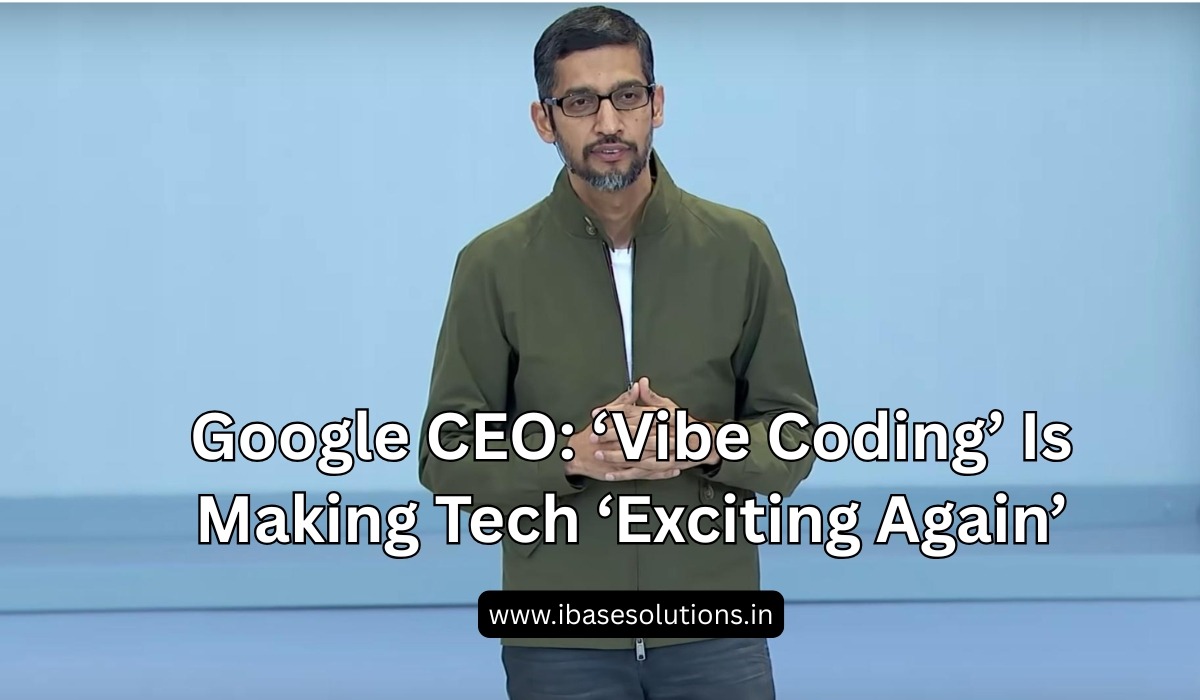
In a new interview on the Google for Developers podcast, Sundar Pichai, CEO of Google (and parent company Alphabet), declared that the rise of “vibe coding” — AI-assisted, prompt-based app/web development — is making software creation accessible again. He argued that with tools such as ChatGPT, Gemini, Claude, and Replit, even people without traditional programming experience — say from HR, finance, or other non-engineering backgrounds — can build functional prototypes and applications. Share Google+2The Times of India+2
Pichai compared this shift to how blogging and YouTube once opened creative careers to ordinary users. He said that vibe coding reduces technical barriers, enables fast experimentation, and makes development “so much more enjoyable.” According to him:
“Things are getting more approachable, it’s getting exciting again.” Share Google
Why It Matters: Lowering the Barriers, Increasing Creativity
The implications of vibe coding extend beyond convenience. Pichai notes that the democratization of code-building could reshape how organizations innovate — empowering non-technical staff to prototype ideas, automate workflows, or build small tools without awaiting a developer team. He described the surge in “first-time CLs (changelists)” at Google by employees who previously didn’t code at all. Share Google+1
In the broader tech landscape, this could mean faster idea-to-prototype cycles, more inclusive teams, and greater agility in responding to business needs. Tools that transform natural language or simple prompts into working code can help organizations test ideas more rapidly, reduce reliance on specialized engineering resources for small tasks, and unlock creativity from diverse people.
For many non-technical professionals, vibe coding promises a way to turn their domain knowledge — HR workflows, business logic, content management — into working tools without learning syntax or frameworks.
The Cautions: Not a Replacement for Traditional Engineering
Despite his enthusiasm, Pichai was careful to stress the boundaries. He argued that while vibe coding works well for low-stakes experimentation, prototypes, internal tools or simple web apps, it is not suited for large, security-sensitive or mission-critical codebases. For those, traditional engineering skillsets, rigorous review, and experienced developers remain essential. Share Google+1
Experts have echoed similar warnings: AI-generated code can help accelerate development, but it doesn’t guarantee robustness, security or maintainability. As such, companies should treat code produced via vibe coding as a starting point — not a production-ready deliverable. IT Pro+1
The Bigger Picture: A New Phase of Tech Democratization
Vibe coding represents a shift in how we think about who can build technology. Just as the early internet unlocked self-publishing and content creation, AI-assisted coding is unlocking app creation and software innovation for a far broader group.
In practice, this could have far-reaching effects:
-
Organizations may become more agile, with non-engineers empowered to test workflows, build internal tools or launch small-scale projects.
-
Employees from non-tech backgrounds may find new opportunities to contribute to digital products — bridging domain expertise with technical execution.
-
Startups and small businesses might create MVPs (minimum viable products) quickly without large engineering budgets.
Pichai summed it up succinctly: “It’s amazing to see, and the worst it’ll ever be.” This suggests a confidence that we’re at the earliest stage of a transformation — and that tools and practices will improve dramatically over time. Share Google+1
Outlook: What to Expect in Coming Years
-
Broader adoption — More companies may start allowing non-engineers to build small tools, internal dashboards, and prototypes via AI-assisted coding.
-
Hybrid workflows — Teams may evolve hybrid models: initial prototyping via vibe coding followed by professional developer review and hardening for production environments.
-
New roles — “Citizen developers,” AI-assisted workflow designers or prompt architects may emerge.
-
Better tools & governance — As demand rises, expect more refined, secure, and collaboration-focused AI coding platforms — plus evolving best practices around code review, security, and maintainability.
For now, vibe coding stands as a powerful, experimental, and promising trend — one that may truly reshape how software is built, who gets to build it, and how fast ideas become reality.