Bulk Whatsapp Sender Service Hyderabad

Buy bulk WhatsApp sender with license online:

bulk-whatsapp-sender-and-autoreply-botIBase solutions very leading software developing company in Hyderabad. In this precipitous world, everything is more about communication. The transmission of information online is much more based on WhatsApp. It is the best platform to get connected to friends, family, and business purposes.

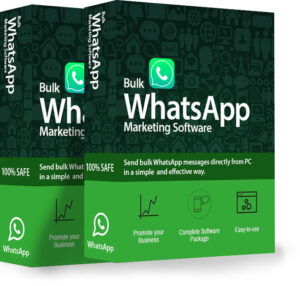
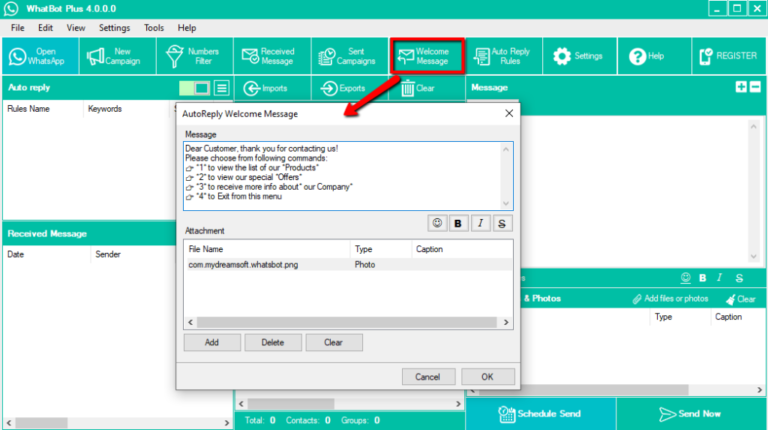
Bulk WhatsApp Marketing Software, which has lost many features like multimedia content sharing, Unlimited message communication, speed control, anti-block feature, contacts filtrate.

Using bulk WhatsApp marketing software, we can share any kind of information to communicate. This platform allows you to share texts, videos, images, and any documents, etc. here, the user can make use of many tools to verify and filter contacts. To extract all the WhatsApp contacts from groups, the Groups Contacts Grabber tool will help you to get them.

This is software is user-friendly, protected and secured, and reliable. The anti-blocking tool reduces the chances to get blocked.

Any user can create and use WhatsApp marketing campaigns and control speed, a delay time between messages and the user can control sleep time.

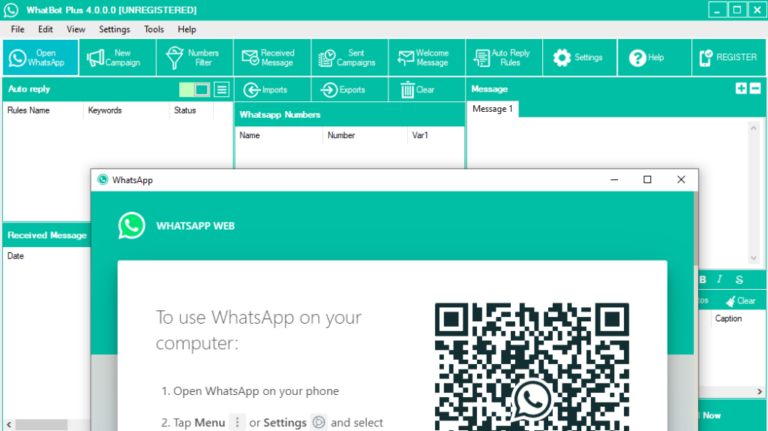
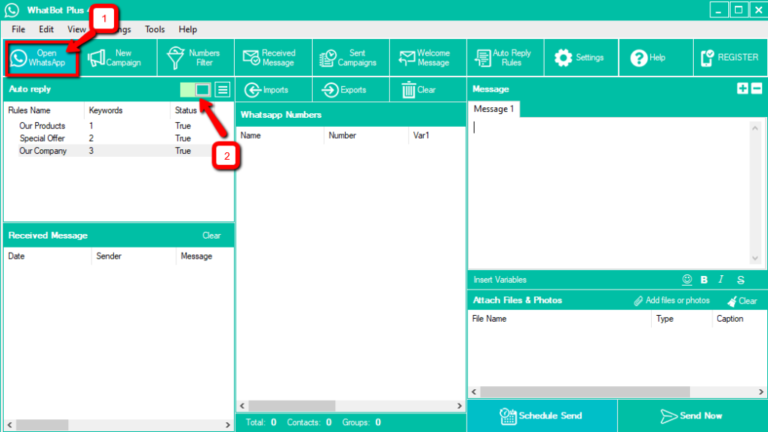
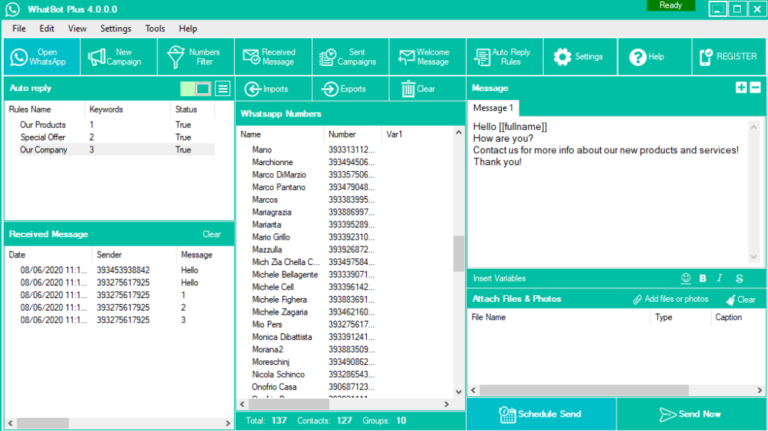
WHATSAPP MARKETING SOLUTIONwhatbot-autoresponder-enabled-2whatbot-main-schreenshot-1whatbot-welcome

FEATURES OF BULK WhatsApp SOFTWARE:

  • Smooth way of sending messages
  • SMS Scheduling Feature
  • Auto – Reply Chatbots
  • Multiple Account Supported
  • Allows Unlimited Messages
  • Numbers Filter Module
  • Anti Block Functionality With Multi text message
  • WhatsApp Groups Contacts Extractor Module
  • Account Switching in Running Campaign
  • Multi-Language Functionality
  • On – Time Campaign Reports
  • Sleep Control Feature
  • Speed Control Feature
  • Delay Control Feature
  • Groups Verifier Module
  • Dynamic Messages Creation
  • Spin Text Module
  • Compatible With Latest WhatsApp API
  • Allows Unlimited Multi-multimedia message (Images, Videos, PDF, Docs, PPT)

Why Are You Still Waiting?

Buy with license online.

Important things to Creating Wikipedia Pages

Wikipedia is an open-source encyclopaedia that will help to create a world and share knowledge. Anyone can publish an article by registering through this site. Having a Wikipedia page about a company is one of the greatest milestones that can promote your brand beneficially.

Would you like to create a Wikipedia page and share your information?

 It can’t be easy- breezy, but all the efforts you keep into this are worth it.

Reasons to create Wikipedia:

On Wikipedia, there is a dump of knowledge, and you can fetch for anything. It can have any information in the world.

Here are the few intentions to create a Wikipedia page:

  1. Technology developed can be of anything and informative.
  2. Your work is noticeable, if you are a founder, it is determined by Wikipedia and considered as a good individual asset of it.
  3. Wikipedia doesn’t let you find information about your topic.

The following steps will help you out in creating Wikipedia Page:

  1. Do your analysis and scrutinization:

Before publishing your content on the page, kindly read the guidelines of the Wikipedia community. It will help you find the challenges on your page. Your content should be verifiable. It is always good to review your page to avoid conflicts. Your content should be unbiased, reliable, and secondary. Once you submit your page for the reviewer process, it might take a few days for approval.

  1. Create an account:

This space is for contributors, admins, and editors. You can be one of these by creating an associated account of it. To upload any piece of information or to edit the content, you need to log in with an email address.

  1. How to begin:

Initially start by doing small changes on the existing web pages so that you will get the knowledge of Wikipedia’s page and the management tool, how the content is managed. Every change you do from your account is recorded under your profile. By doing this you’ll get familiar with how Wikipedia works.

  1. Collect article related info:

Take enough time to collect the information that is related to your article. Your content should be unique and informative and everything that you upload from your account is verified. Do not duplicate the information that already exists. You need an arbitrator to support your article it might be websites, videos, journals, or any other articles.

Keep your article simple and straight, and you can’t be incriminated forms-interpretation.

  1. Creating Draft:

Once you log in with your account, To modify the content on your page, you can add your page to the sandbox. Reliable references should be provided to your article. The minimum size of the article is 1500 words, and it should be less than 5000 words. Before publishing your article ask someone to review your article.

  1. Prepare to submit for review:

Here is the last step, submitting your article for reviewing process. Make sure it has followed all the regulations. It is a moderate hey process, it might take few days or few weeks to get a response for your approval process. You need to get through this process in a more efficient way.

Once your article is live, all your efforts are paid off. But there are also the same chances of the article being deleted.

Editors might do some changes to your articles like changes in the title and additional comments also be added for the improvement of the article. Make sure you are monitoring your page to get identified the edits that are done on the page.

I hope this article adds a little more knowledge to you in creating Wikipedia pages.

All About Our Android App Development Process

To take your business into the market and stand it top, you need to cultivate a wide range of ideas. But in converting those ideas into real-time achievements lies the actual success. One such strategy of developing your business ideas into practical accomplishments is to have one app developed for your enterprise. There are billions of android device users out there around the world and keeping this number in mind, our android app development process adopted by our engineers would conceive greatest of android apps that hit million download mark.

Our android app development process is not limited to just smartphones or tablets, but it is widespread over every android device out in the market for user convenience. Our developers, managers and engineers make it a point to explore the whole android world and conquer it with the best-performing android apps that goes well on any android device.

The primary developing code languages our android app development process includes is either java or kotlin as they yield user-friendly experiences.

Here is what our Android App Development Process contains

Our company’s involves a key app development strategy that reciprocates and strengthens clients’ business goals besides providing the best possible seamless user experiences.

Analysing:

Our first step is to discover and bring out the possible requirements for the application. Following this, our engineers do list the competitors, analyzing the chances of monetizing the app and figuring out the technical feasibilities.

Designing:

Next comes the designing part which includes designing the UI – user interface, which forms the crucial part as the majority of user vote for neatly and well-formatted applications that contain seamless navigation. Wireframing is the crucial concept our designers adopt in UI designing.

Architecture:

Defining network layers, UI layers, database layers and creating frameworks taking cues from the wireframes form this important step in android app development process.

Development:

Apart from developing the code, developing the frontend, backend and reviewing the code in the loop is what we do in the development stage.

Testing/Quality Assurance:

Once the code is ready, frontend and backend are designed, our technical team performs various real-time testing methodologies on real android devices to make sure the app keeps up with the initially claimed performance levels. Our Quality Assurance team performs testing the functionalities of the app on various android devices – smartphones, tablets, smartwatches and Android TVs. Based on the results we do provide improvements wherever needed.

Submission and Distribution:

Once done with the quality assurance, our team would submit the seamless android app to the Google play store which unlike the other app stores, accepts and includes the submitted app in its vast collection available to the users. Following which we do post submission testing to analyze further updations and then do enterprise distribution.

Post-launch:

Once the android app is onto the Google play store, users start downloading it. So, it is needed to check for any app crashes with increased user number and traffic. Also, monitoring user engagement time and marketing the app are the other activities included in the post-launch period of the app.

Last but not the least, we use a high-performance database to store, manage and fetch users’ crucial and confidential data. User data security is our main agenda, our app development process adopts high-quality data managing techniques and methods.  

Whether your enterprise is a startup budding to compete with the giants in the business world or an already established firm, you need to keep the contact intact with your users and at the same time, try ballooning your consumers. This is possible with incorporating new ideas into the android world and android apps like adding audio-video features, linking up with social networks, exploring the wearables in the android market, etc.,

Let us design your dream app that lets you bring the change in the digital era.

Also read:

Best IOS Application Development Services

6 Important Stages In Mobile App Development Process

Best iOS Application Development Services We Offer

Best iOS Application Development Services We Offer:

For a spectacular business idea that you have to reach out to the millions of smartphone users, you need an interface that best reflects your views and ideas. This is possible only through an app that could connect smartphone users to your business. Especially, when it comes to iOS app development, you need to look out for the best in the market iOS application development services and the company that owns such people. We are in them. 

With the best possible user experience and flawless coding techniques, we have the efficient workforce to design and develop your ideas into iOS apps not just for iPhones, but for iPads, Apple TVs and Apple smartwatches too.

For designing and developing apps for any of your Apple devices, we follow:

Agile Methodology 

Putting simple, adhering to agile methodology in the iOS app development process refers to replacing the high-level tasks and designing methods with short and small work phases to avoid frequent redesigning the whole working loop. Through this method our we involve our client teams in the working process, product designing and thus, can achieve their business goals on time with high-quality user experiences. 

Planning

To stand top among the competing apps, our developing team would brainstorm for the best possible strategies to develop your business ideas into practical working applications.

UI and UX

As our developing team are aware of the updated trends and users’ requirements, they design smooth and the best user interface for enhancing user experience that suits for any Apple devices you use.

Development

With great user interface and experience, our engineers and managers strive to deliver your app for any iOS device on time and also make sure it passes through Apple store’s quality checks in the first place without any errors. 

Testing

Our testing team leverages the real Apple devices be it tabs, iOS smartwatches and Apple TVs to test the app and make any necessary improvements in the speed and navigation. 

iOS app development
iOS app development

So, for serving the best iOS applications that go well with Apple devices and any iOS wearables, we are here to help you out and stand tall in the digital market. Since our designing and development team are well aware of the updating Apple features, iOS standards and iPhone and iPad users’ requirements, 

Even though there is a fast upgrade in the technology world, there is ‘n’ number of tools and techniques, our iOS application development services team relies on the efficient coding language and reliable tools to bring forth the required application of iOS devices. The two major things our developing team keeps in mind before developing the app for iOS devices are user data security and consistent performance update. 

6 Important Stages In Mobile App Development Process

It is proved in many surveys that over a fourth of internet traffic is from mobile applications. Smartphone users rely a lot on mobile apps rather than other browser versions for their day to day requirements and mobile activities. Be it communication, entertainment, shopping and any others. So today, in this fast-growing digital era, every business enterprise needs to take their business more closely into the market via app development strategies. For this, they need to cultivate an outstanding and flawless mobile app development strategy and this is possible only by adopting a proper mobile app development process and following it thoroughly.

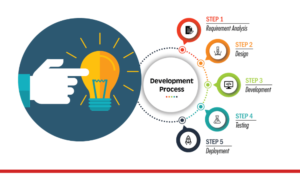
Here, we let you know in detail about the key stages in the mobile app development process.

1. Strategy

Not every idea can be cultivated into an app and not every app becomes successful though. It is important to have a proven strategy and follow it to yield your idea into an app that attracts users.  

A well-structured strategy involves a few questions to ask yourself. They include:

What is the app for?

Who are your target users?

Who are your competitors in the market? 

What is the best suitable mobile platform for your app?

With these in mind, you have the clear strategy of your budding app in mind and so, you could easily jump into the next level of the mobile application development process.

2. Analysis and Planning
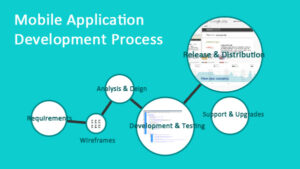
This is where your app takes its original and final route map to turn out into a finished product. For this, you need to design a roadmap that constitutes the functional requirements for your app, the necessary use cases. When you have assessed and grouped the requirements for your app’s development including the target time, estimated cost of development and other resources, you have made it into the launch. 

The analysis includes which platforms your app is targeted onto. iOS, Android and Windows. If so, you need to deploy different app developers for different platforms to make sure your app is flawless. 

Planning here starts from your app’s name in the app store. Ensure that your app name is unique yet catchy, easily memorable by the users. Also, it should not contain any replicas or duplicate names in the app store. For doing so, you need to perform an app store research for making sure your app’s name is not already included.

3. UI and UX designing

This stage includes users’ adoption policies. For any app to sustain and succeed, it has to have a well-equipped and designed user interface. Seamless navigation, attractive user interface design can lure users to adopt the app. Whereas, UX- user experience design should be in such a way that it engages the users for a long time. A well-structured interface lets the users interact with the app and its features. And a flawless menu, error-free page experience decides whether your UX design has succeeded or failed. So, the more furnished and intuitive your app’s UI and UX designing are, the more is the success rate for it.

And workflows, wireframes, style guides and mockups. Let us see through these four designing elements. 

Workflow construction uses diagrams depicting the data outflow and inflow within the app. The workflow diagrams show how users interact with the app, what data does it collects and reflects. Overall, these represent the user interaction process and navigation within the app. 

Wireframes are nothing but the digital forms of app design sketches that the designers work with. How the app’s functionality would look like and the user experience is more concentrated in these work frames. 

Styleguide includes the type of font you zero in for your app. The colour palette, the size of the logo of your brand etc. Further, the type of style guide you adopt for your app should be device-specific – different for different mobile platforms. 

Mockups are another important part of your app’s development process. The style guide you have finalized for your app is applied to the wireframes designed prior. 

4. App Development This stage of app development is nothing but programming the app. It involves analyzing the technology, technical architecture, requirements and functionalities. The app programming typically includes three phases and they are explained in brief below.

a) Backend programming: Backend technology is nothing but server or database to support the functions of your app. To achieve the planned mobile functionalities you require the right database or in case there is an existing database it requires any modifications further. 

b) APIs: The communication system built between backend technology and the actual app. 

c) Front-end programming: To develop the front-end, the actual app it is, you need to finalise on a programming language which is different for different mobile platforms. iOS apps and android apps run using their respective technology stacks. Whereas a backend can be programmed using any web programming language and database as a choice. All that you need is the aptest choice made for your mobile app’s usage. 

5. Testing 

This stage in the mobile development process is crucial as much as designing and programming since it results in security, reliability and loyalty that your app gains. Quality assurance testing involves the usage of test cases by the testing team. To get the right mark without any flaws, your app needs to undergo the below testing methods.

a) User Experience Testing: The visual impression, interaction with the users, and the flow of navigation everything comes under the user experience. The final impression that a user has on the app is what relates to this testing. Right from the font styles to colour schemes and icons and their placements, the in-app functionalities should match the initial designs and mockups of your app. 

b) Functional Testing: An app’s functionalities are tested based on the scenarios of how an end-user is going to use the app. What bugs he may experience, what outputs are going to be mismatched and other functional features are tested basing mock users’ experiences. 

c) Performance Testing: Completely different from functional testing. It measures the speed of your app, its consumption of user’s phone memory, battery draining, internet connection and speed requirements. This may vary with the increase of decrease in the number of users. So, you need to test the app’s performance with as many users as possible. Finally, the app’s performance capability should be maximum.

d) Security testing: To ensure user data safety and security, the app’s development team needs to deploy a separate security assistance team. The login session timeout length, user credentials, data storage both in front-end and server should be monitored and secured to ensure there are not data leakages and vulnerability to hacks. 

e) Platform testing: Testing your final app on different mobile platforms and different mobile devices is as much important since we do see a new mobile device popping up from mobile giants every few months. Also, our mobile operating systems keep on updating frequently. So, to check whether the app can adapt to the new devices and updated mobile OS, it is needed to perform mobile device testing. 

6. Deployment

Once you are done with the testing methods and yielded good results, the next and final stage of a mobile app development process is to submit the app to the app stores – Apple app store and Google play store. But for this, you need to keep hold of some details regarding your app like – app title, description, purpose, keywords and icon. 
Once done with the data collection and submission, Google play store directly approves your app to be available on the app store regardless of the review process. Whereas your app to be available on the Apple app store, it needs to undergo a review process which may take from days to weeks. 

Once your app is available on the app store of the mobile platforms, you have to keep track of the user reviews, feedbacks, reported issues, etc., to improve any quality or functional related issues and bugs. This proves to increase the users’ loyalty and engage them with the app’s updates. However, an update of the app also needs to go through the same submission, review and acceptance process from the app store. So, keep updating your app with respect to the technological advancements and latest mobile devices.

All the best for your mobile app development.

Also read: 7 Top Reasons Why Mobile App Marketing Is Crucial

✉ Chat via WhatsApp